What Does Research Say About...
Evaluating Integration of Technology in the Curriculum
Introduction
Instructional technology is currently implemented in many classrooms throughout the nation. Students can work on various blended learning platforms, research topics for group projects, communicate via social media platforms, and create, and share presentations beyond the walls of the classroom (Ito et al., 2020; Lonergan, 1997). Educators deliver instruction via slideshow presentations and digital curriculums while engaging in professional development and collaborative opportunities with colleagues (Oddone et al., 2019; Sickel, 2019). Many educators may be using technology ambiguously (Surowiecki, 2014) and can deepen their understanding of the modalities of technology being utilized in instruction. A tool to determine how technology is implemented throughout instruction, the Technology Integration Matrix (TIM), was developed by the Florida Center for Instructional Technology (Florida Center for Instructional Technology, 2019).
Technology Integration Matrix (TIM): Overview
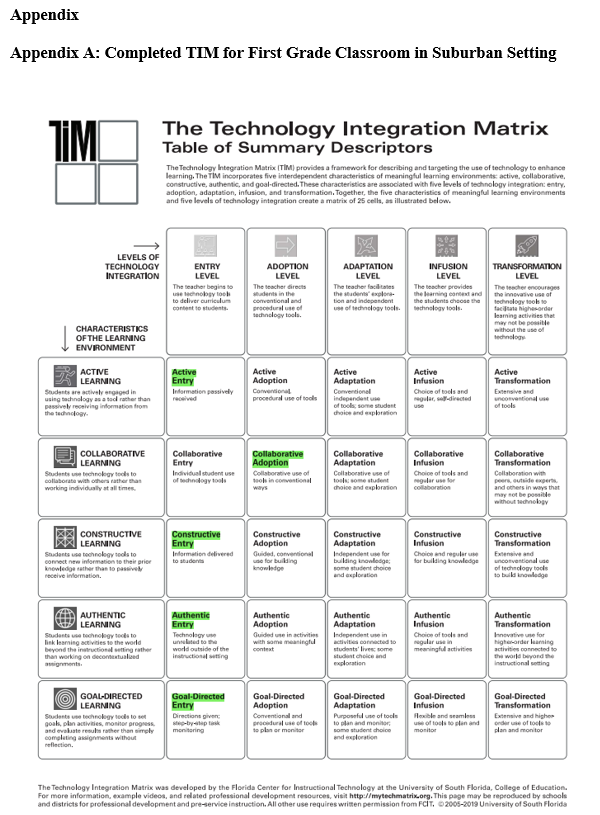
The Technology Integration Matrix (TIM) (Florida Center for Instructional Technology, 2019) is a tool used to determine how technology is used in instruction. It consists of five levels of technology integration: Entry Level, Adoption Level, Adaptation Level, Infusion Level, and Transformation Level, and five characteristics of the learning environment: Active Learning, Collaborative Learning, Constructive Learning, Authentic Learning, and Goal-Directed Learning (Florida Center for Instructional Technology, 2019). The matrix is designed to move from teacher-centered instruction (Entry Level) to student-centered instruction (Transformation Level) by following the levels of technology integration, and the learning environments present ways in which technology is being used in the classroom. At the Entry Level, the teacher uses technology to deliver instruction. At the Adoption Level, the teacher initiates the technology students will use during instruction, and the teacher dictates when as well as how technology will be used. At the Adaptation Level, teachers facilitate the use of technology, releasing students to explore and use technology independently. At the Infusion Level, teachers provide the context of learning and students choose the technology they would like to use to implement or extend their learning. At the Transformation Level, teachers encourage the use of technology for students to exercise their creative and innovative insights for learning. The TIM Matrix (Florida Center for Instructional Technology, 2019)is used among various levels of educational institutions including grade schools and postsecondary schools (Yaw Odame Gyau , & Ernest Kwabena Gyan,, 2023) to determine the current level of technology integration in instruction (Florida Center for Instructional Technology, 2019). Once a placement is identified, educators can determine the next steps to enhance the integration of technology in instruction to foster student-centered integration.
Description of Current Learning Environment
The TIM was applied at a Title I elementary school serving primary students, Pre-Kindergarten to second grades, in a suburban setting in a large urban school district. A first-grade self-contained classroom consists of twenty-one students, of which three students are English Language Learners, two students receive special education services for Speech and a Specific Learning Disability, and three students have been identified by district data as having probable dyslexia. All students receive free breakfast and lunch. There is a 1:1 ratio of students and laptops, and the latest version of the interactive television. All district curricula are available both digitally and tangibly and instruction is delivered face-to-face with an emphasis on blended learning platforms (Smaldino et al., 2019).
Current Level of Technology Integration
The TIM Matrix (Florida Center for Instructional Technology, 2019) was used to determine the level of technology integration in a first-grade classroom. The TIM Matrix (Florida Center for Instructional Technology, 2019) identified an Entry Level position in the following learning environments: Active Learning, Constructive Learning, Authentic Learning, and Goal-Directed Learning. An Adoption Level was identified in the Collaborative Learning Environment. (See Appendix A) An Entry Level placement was identified in both the Active Learning and Constructive Learning Environment because the teacher delivers instruction primarily via a digital curriculum, Benchmark Advance (Benchmark Advance Education Company, 2022) and Reveal Math (McGraw Hill, 2020) on the interactive television and students are directed to use technology at a predetermined time; there is no flexibility. Students passively receive information during instructional delivery by listening to oral readings or math instruction and either discussing content or writing about content.
An Entry Level placement was identified in the Authentic Learning Environment because instruction occurs only in the classroom and does not extend to other classes beyond the instructional environment. Technology is not used as a bridge to the world or other first-grade classrooms locally or nationally. An Entry Level placement was identified in the Goal-Directed Learning Environment because students do not monitor their progress on the Blended Learning platform iReady (Curriculum Associates, 2011). The teacher displays a class average for each subject, and students are directed to check their usage to adhere to the district’s weekly goal. Most students can check their usage when directed to do so; however, very few initiate this task independently.
An Adoption Level placement was identified for the Collaborative Learning Environment because students work together to complete learning tasks for formative assessment activities through interactive learning games such as Kahoot (Versvik et al., 2012) or Pink Cat Games (Rodger, 2012) that allow students to interact in groups to review learning content before a summative assessment. When engaging in learning platforms, students are placed into groups and encouraged to discuss learning content from phonics skills to math facts. Students are also encouraged to use technology during research opportunities. For example, students were encouraged to extend their learning of groundhogs after viewing a live feed of the Groundhog’s Day Celebration in Punxsutawney, Pennsylvania. Students were driven by their inquiries to research the diet and habitat of groundhogs, the geographical location of the Groundhog’s Day celebration as well as the common activities in Punxsutawney.
A lesson plan following the ASSURE model (Smaldino et al., 2019) will be developed to move students from the Entry Level of the TIM Matrix (Florida Center for Instructional Technology, 2019) to the Adaptation Level of the TIM Matrix (Florida Center for Instructional Technology, 2019). Students will use Microsoft Teams (Microsoft, 2017) to construct Announcements about a historic African-American figure of their choice.
Limitations
The barriers contributing to the limitation of the integration of technology include district mandates of blended learning platforms and classroom instructional schedules. Students are required to engage in i-Ready (Curriculum Associates, 2011) Reading and Math lessons for 30 - 45 minutes each week as well as ninety uninterrupted minutes of Reading instruction which includes mandated, data-driven small group instruction, and writing. The math instruction includes 45 minutes of whole group instruction and 30 minutes of center rotations. Resource schedules for Art, Media, Music, and Physical Education must occur for 45 minutes, three days per week, and recess must occur for 20 minutes each day per state mandates. Therefore, the most impactful barriers are district and state mandates for the daily instructional framework.
Another challenge is the developmental levels of the children. The students range from six to seven years of age and have limited knowledge of basic computer skills. One of the main goals of first grade is to teach students their online user credentials. Once this task is completed, students are gradually introduced to other functions of the computer, such as accessing the district blended learning platforms. Then, students are introduced to digital learning tools such as SplashLearn (StudyPad Inc., 2010) and Epic Books (EPIC!, 2013) to provide some exposure and foster some independence.
Students can receive instruction on how to use search engines on the Internet to research topics of their choice and extend their learning in group projects of their choice. Students can be given a topic such as animals and taught to use PBS Kids (JAX PBS, 2021) to research animals in the Wild Kratts Creaturepedia (JAX PBS, 2021). Students can collaborate in groups to create a presentation about an animal of their choice. Students could email a zookeeper at the various zoos internationally, nationally, or locally, at the Jacksonville Zoo (Jacksonville Zoo and Gardens, 1987), to ask questions about their animals. Students could move to the Adaptation Level and Infusion Level of the TIM (Florida Center for Instructional Technology, 2019) if these example tasks are implemented.
Summary
The TIM (Florida Center for Instructional Technology, 2019) is a reliable tool educators can use to identify the levels of technology integration in their instruction. Educators can determine ways to enhance the use of technology and move toward a more student-centered way of instruction. Educators can also analyze the challenges and barriers that contribute to their placements and formulate a plan to engage, guide, and support students to use technology freely to facilitate their learning. Scaffolds can be determined as well. Educators can also advocate for more flexibility in their instructional schedules to address time constraints. With the use of TIM, educators can promote and encourage students to be independent, innovative, and creative learners who can build communities beyond the walls of the classroom (Goldie, 2016; Ito et al., 2020; Surowiecki, 2014).
References
Benchmark Advance Education Company. (2022). Florida benchmark advance k-5 ela program, k-5 ela curriculum, k-6 ela curriculum, core program, ela program, benchmark education, benchmark advance, florida benchmark advance, benchmark advance florida, benchmark education. Florida Benchmark Advance, Benchmark Advance Florida. https://benchmarkadvance.com/florida/
Curriculum Associates. (2011). I-ready learning. Curriculum Associates i-Ready. https://www.curriculumassociates.com/programs/i-ready-learning
EPIC!. (2013). Instantly access over 40,000 of the best books & videos for kids on epic. Epic - Books for Kids. https://www.getepic.com/about
Florida Center for Instructional Technology. (2019, June 1). Technology integration matrix. TIM. https://fcit.usf.edu/matrix/matrix/
Goldie, J. (2016). Connectivism: A knowledge learning theory for the digital age? Medical Teacher, 38(10), 1064–1069. https://doi.org/10.3109/0142159x.2016.1173661
Ito, M., Arum, R., Conley, D., Gutierrez, K., Penuel, W., Peppler, K., Pinkard, N., Rhodes, J., Tekinbas, K. S., Schor, J., Sefton-Green, J., & Watkins, S. C. (2020). The connected learning research network: Reflections on a decade of engaged scholarship. Connected Learning Alliance.
Jacksonville Zoo and Gardens. (1987). Meet our keepers. https://www.jacksonvillezoo.org/blog/posts/meet-the-keepers
JAX PBS. (2021). Wild kratts. Wild Kratts | PBS KIDS. https://pbskids.org/wildkratts/creaturepedia/
Lonergan, D. (1997). Network science: Bats, birds, and trees. Educational Leadership, 55(3), 34–36.
McGraw Hill. (2020). Reveal math. https://www.mheducation.com/prek-12/program/microsites/MKTSP-GIP20M0.html
Microsoft. (2017). New microsoft teams for education (edu) - microsoft teams. Microsoft Teams. https://learn.microsoft.com/en-us/microsoftteams/new-teams-education
Oddone, K., Hughes, H., & Lupton, M. (2019). Teachers as connected professionals. The International Review of Research in Open and Distributed Learning, 20(3). https://doi.org/10.19173/irrodl.v20i4.4082
Rodger, M. (2012). Pink cat games – fun educational games that keep learners engaged. Pink Cat Games. https://www.pinkcatgames.com/
Sickel, J. L. (2019). The great media debate and tpack: A multidisciplinary examination of the role of technology in teaching and learning. Journal of Research on Technology in Education, 51(2), 152–165. https://doi.org/10.1080/15391523.2018.1564895
Smaldino, S. E., Lowther, D. L., & Mims, C. (2019). Instructional technology and media for learning (12th ed.). Pearson.
StudyPad Inc. (2010). Splashlearn: Fun math & ela program for prek-grade 5. SplashLearn. https://www.splashlearn.com/
Surowiecki, J. (2014). The collective intelligence of the web. The New Yorker.
Versvik, M., Brand, J., & Brooker, J. (2012). Kahoot! Kahoot!. https://kahoot.com/
Yaw Odame Gyau , & Ernest Kwabena Gyan,. (2023). Integrating technology into academic programmes in heis: The perspectives of policymakers in covid era. https://doi.org/10.5281/zenodo.7512308